
What Optical Illusions tells us about Dyslexia
Dyslexics can experience images that appear to flicker, move, rotate, float or change. But actually, ALL people experience these things.
When visual effects trick us with images, we label the IMAGE: the IMAGE is an optical illusion.
When visual effects trick us with text, we label the PERSON: the PERSON is dyslexic.
But actually text can also be an optical illusion. What is and isn’t an optical illusion is subjective. Some images appear inherently unstable to most brains and some only to a few. Not all optical illusions 'trick' all people - it depends on fine tuning of perception processors in the brain - but all people can be made to experience images which appear to flicker, move, rotate or float.
Let’s look first at a stable image, such as this tree. In the time allotted for perception, which is about 1/75th of a second, the brain does not process the shape of every branch. Instead, it’s more efficient to process just a few samples. These measurements vote on what memories (clusters of previously stored measurements) are a good match. From even 1 or 2% of the possible measurements, the brain can connect to previous memories of trees. As the eye continues to look at the image, more measurements are taken and more votes and connections are made. But ALL of these say the same thing. They just reconfirm that the image is a tree. You might notice new details to refine the original conclusion, but not anything that contradicts it. Most natural images are very repetitive. and the brain is optimized for that type of image.

But this optimization doesn’t work well for the images below. They appear unstable to most people because the brain’s ‘voting’ system of perception is coming up with slightly varying conclusions from moment to moment, depending on which subset of measurements is processed in each frame of voting.
This may appear to flicker:

In this example, peripheral votes are not aligned with the votes in your narrow focal point. The image has two circles which never cross but appear to move or cross, especially in your peripheral vision or as your focal point moves around the image.
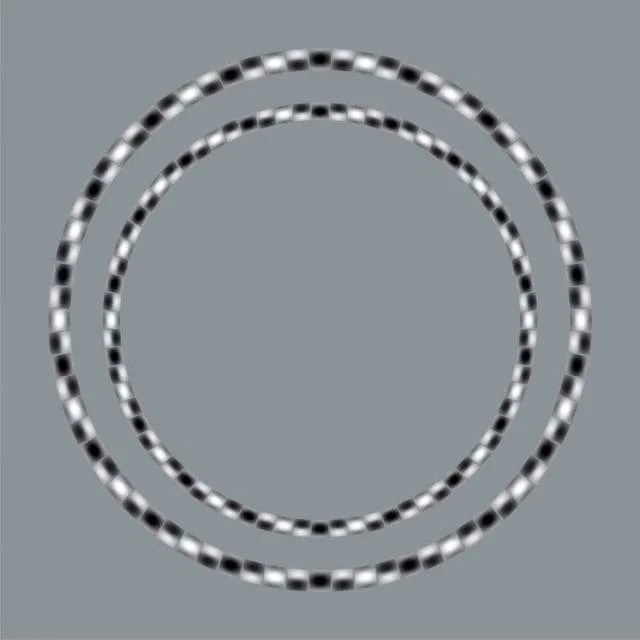
The center section may appear to be a separate block from the outer image, especially as you scroll:

The sections may appear to rotate, especially as your eye moves around the center.

These illusions trick 80-90% of people, but the percentage of people varies by illusion. B&W text is an optical illusion for about 5% of the population.
Imagine reading a whole book that was moving or flickering? It's exhausting. The goal of RexLex is to alter the text in ways the brain finds easier to process, breaking the optical illusion and stabilizing the text.
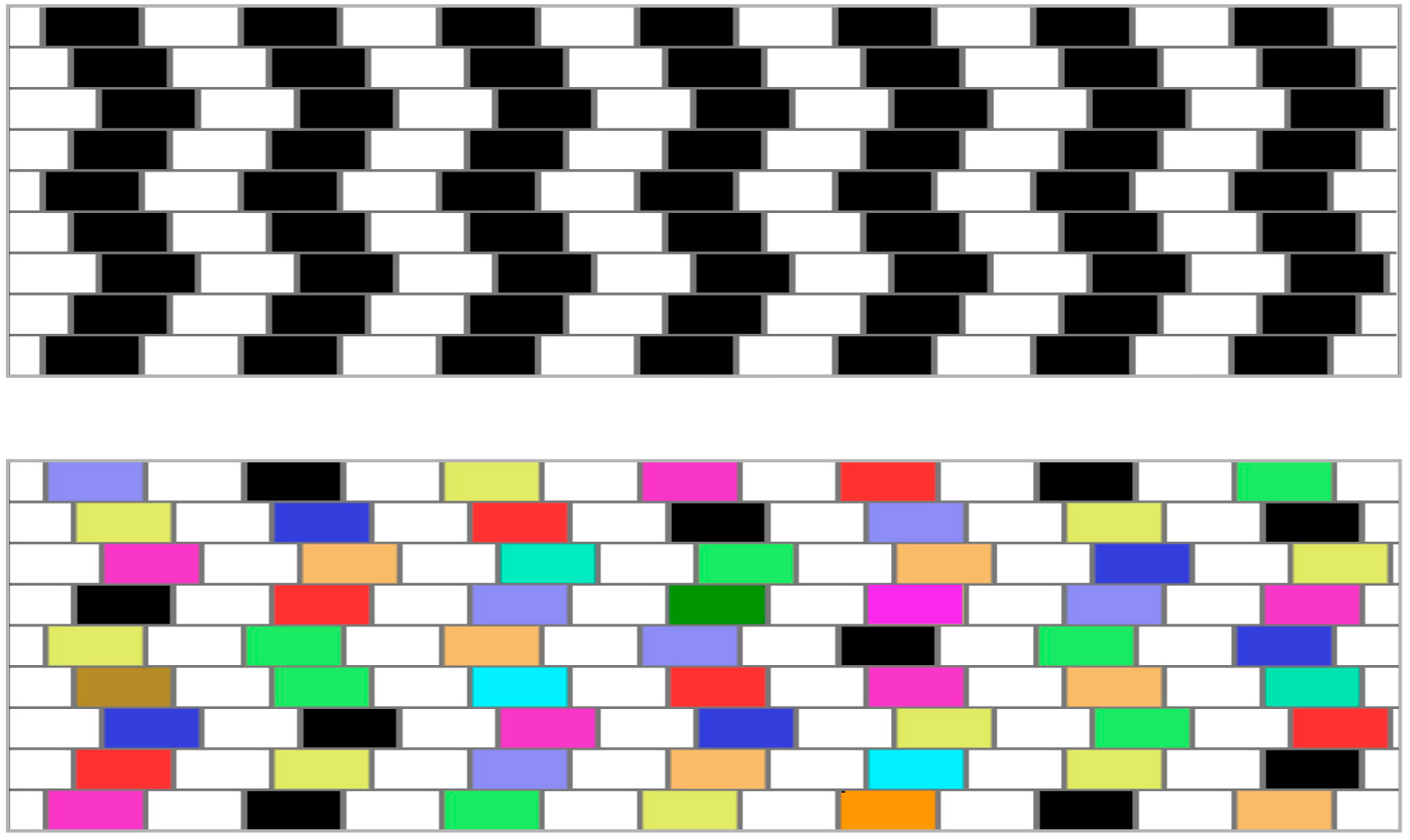
This pair of images is interesting. The horizontal lines are straight and parallel, but in the B&W version they seem to be diagonal. This is due to the fact that the brain is trying to fit the blocks into a pattern it has previously established. Since the rectangles don’t line up vertically, the brain is looking for a pattern to account for that. It draws the conclusion that this must be because they are sitting on crooked lines. The brain is matching them to poorly constructed, teetering bricks. The grey lines evoke mortar further pushing perception towards the brick pattern. Some viewers even report that the bricks seem to moving, or sliding off.
The randomly colored version actually appears straighter and more stable to a lot of viewers. Many people assume that the increased randomness would necessarily make the image less stable, but in this case it’s the opposite. The brain has no problem processing lots of colors or other info. The volume of info presented to the brain doesn’t cause it confusion, but rather it’s the direction of the information. Where it gets into trouble is when it tries to shoehorn what it’s seeing into established patterns. When the colors are random, the brain is less able to fit them into an established pattern. In other words because the black and white image is too close to something the brain recognizes, the brain tries to account for it, and this can actually throw it off. If the brain doesn’t recognize the image as something it already knows, the brain is more likely to see it anew, and thus as it actually is!
To understand this issue of of how perception is trying to match everything into established patterns, check out the McGurk Effect below.
B&W letters can suffer from a very similar problem. Dyslexics don’t have a problem seeing and their misperceptions are not random. They don’t see an english letter and think it’s a flower. Or even a chinese character. Instead, like with McGurk, their perception is close but being misdirected to a similar yet incorrect letter. And these letters themselves then direct or misdirect towards a whole word. One perception cascades to the next.
These, and hundreds of other illusions, are very instructive to understanding how perception works and how it can go awry. The purpose of RexLex is to direct perception towards the intended memories by removing ambiguity.