
Comparison to Other Typefaces
The most common typefaces such as Helvetica and Arial, use similar shapes for many letters, creating conflicts.
A typeface called Open Dyslexic attempts to resolve conflicts by making each letter shape distinct. This does provide some additional data that the brain can use to index letters, but all within the dimension of shape - a dimension which has already proven to be challenging for dyslexics.
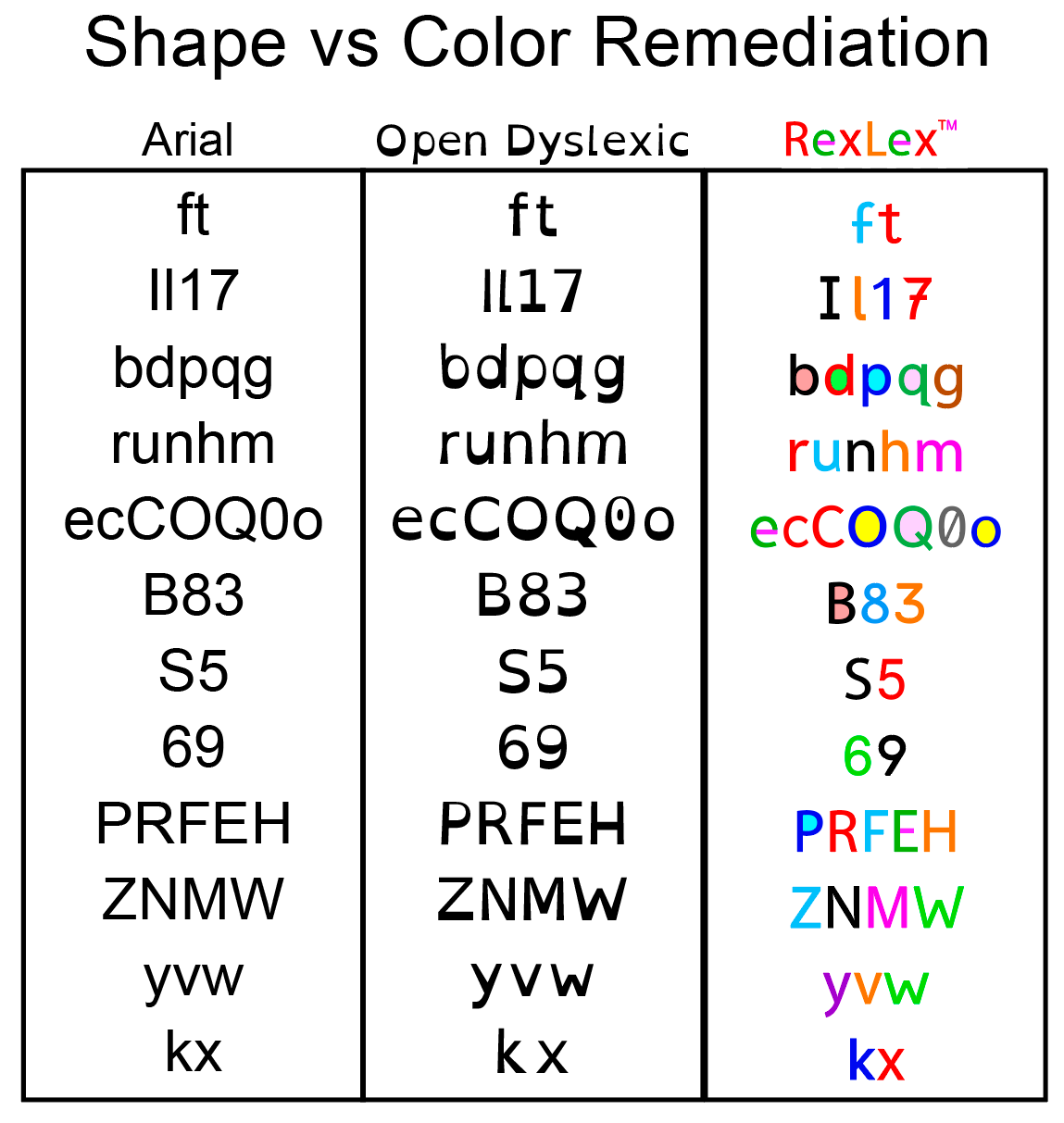
RexLex does make some shape clarifications, but in general relies on adding color. It’s very clear from the comparison chart that it’s color and not shape that provides the most distinction. Why? For perception, the precision of any single dimension is less important than the multitude of cross referenceable dimensions. Since objects in the natural world can have a wide variation along any single dimension, and since perception is just a fraction of a second, the brain is designed to favor cross referencing over measuring any single dimension with increased precision. In fact, during the very limited time window of ‘perception’ (approx 1/75th of a second) the brain samples only a small subset of data, making detailed measurements of all input impossible. Precision of any one dimension is skipped in favor of cross referencing a rough cut of many. This is a great strategy for most natural objects, but not for man made B&W text.
In addition to problems stemming from the limited time of perception, single dimensional input can cause a problem with memory formation and long term maintenance. Our brains normally ignore and merge small variations along any single dimension into an average because such small variations don’t help much with perception of natural objects. The brain does not need to store a separate memory cluster for each leaf or grape on the vine, and instead stores representative samples. However B&W text requires the brain to store small variations in shape, which it otherwise might normally compress. Most brains can make this adjustment, and some cannot. Some people barely ever notice that bdpq are the same shape just rotated, because their brains have stored them as 4 separate shapes. Others always see them as rotations of just one shape for which they must constantly adjust to tell one from the other. Distinct colors allow the brain to reorganize and maintain them as 4 clearly distinct memory clusters.
RexLex is clearly the most distinct typeface engineered for dyslexics. It taps unused dimensions: Red, Green, Blue & Variable Brightness. Additionally, peripheral vision, which does not meaningfully decode shape, can decode color, providing an extra set of optical measurements to both cross reference memories and guide the focal point.