
How Long Does it Take to See Improvement?
Perception is a complex machine which connects sensory input to memories. It has many parts and consequently, dyslexia can be caused by any break in the chain of those parts, so it’s not the same for everyone. There are many factors:
Shape and Color Measurements
Speed of Measurement
Sampling Rate per Frame
Eye motion rate per frame
Frame Duration
Search efficiency
Search Filtering (eg, does the brain map to the top result or the top 20?)
Instant Memory
Instant Compression
Number of Memories Cycled back for context (related to ADHD)
Memory Formation
Long Term Memory Compression and Retention
These tools are all balanced and any deficiency or imbalance can cause lower identification accuracy and be interpreted as dyslexia.
The time it takes to see improvement is very dependent on which of the above or other tools is the source of the problem. With some cases, color can instantly have a positive impact, even without memorizing the colors at all. But in most cases, color must be memorized and, in these cases, it will probably feel uncomfortable or distracting until the colors are fully internalized. Don’t worry. Huge effort is not required. Instead, consistent RexLex use will cause the brain to rewire gradually. As with foreign language learning, immersion is key. If the brain can fall back on old ways, it will. During the learning stage, avoiding black & white text in favor of RexLex will cause the brain to add new neural networks far more quickly.
How RexLex might help Instantly
Color may work instantly by merely alerting the brain that letters are different from one another. It’s not that the brain knows which colors map to which letter, it’s that the brain recognizes letters are distinct from one another.
Avoid Instant Compression: Perception is deleting almost all sensory input very quickly in order to save space. For example, if I see 1000 leaves, I don’t instantly perceive them as unique things, but as a bunch of similar things. They are usually compared and compressed BEFORE they enter consciousness. This is efficient for leaves, but can be a problem for letters, which despite similar shapes, need to connect to different memories:

The letters oc and oo have very similar shapes and may be prematurely compressed, even before the sentence is fully decoded. But in the color version, the brain is given more clues that the two letters are different. Even though the brain may not know that the c is red and o is blue, at least it can tell that they are different things and should not be compressed into merely a group of 2 of the same thing.

Distinct colors clarifies whether to identify 2 narrow shapes or 1 wide shape: This may seem similar to compression, but this occurs at the voting/search phase of perception, whereas compression occurs at the memory/buffer stage. A color difference creates additional types of edges, helping the brain to quickly rule out words with the wrong number of letters, even if it hasn’t memorized the color mappings.
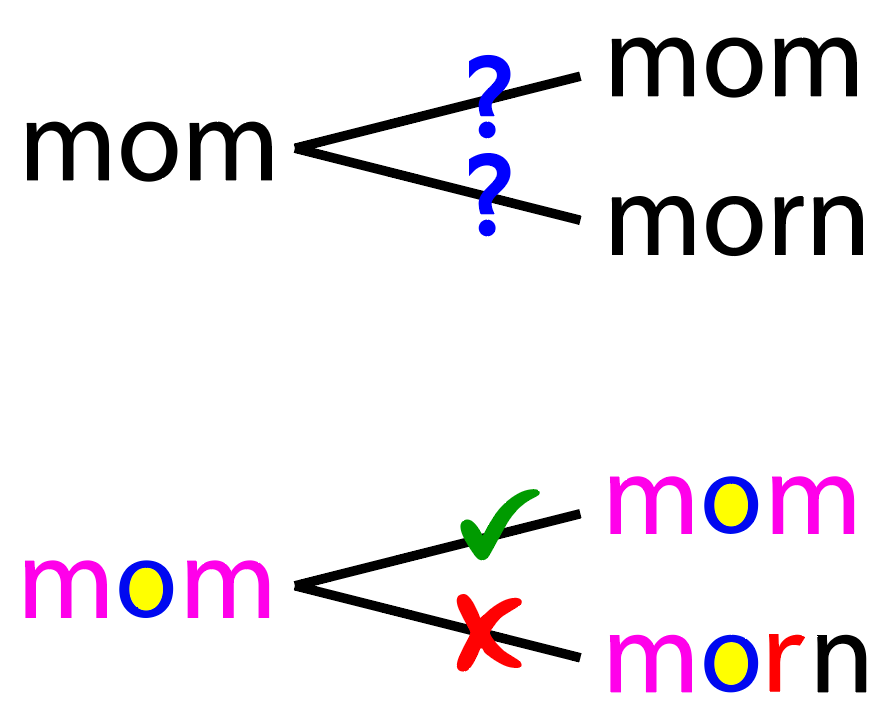
More Voting Time: Perception is using measurements to sample input and ‘vote’ on which memory has the most similar measurements. As described in the intro video, the voting system can run into problems if it’s too quick and doesn’t collect enough samples in the initial vote - having a perpetually quick frame rate can increase identification errors - it jumps the gun.
However, the frame rate may not be the same for all data. Having all the letters be the same color can lead to shorter frame rate, as the overconfident brain concludes that all the homogenous data aligns to its first (wrong) pick. Introducing unknown variables, like varying colors, can cause the brain to “keep the polls open a little longer,” while it sees if the difference means anything. Even if the colors don’t actually vote for the right memory (because color memories haven’t formed yet), the lengthened vote time, ironically, lets more shape data in, increasing accuracy.
How RexLex might help Gradually
Memorized Letter Colors: This is the primary pathway for RexLex to help dyslexics. In addition to just alerting the brain that letters are different, the brain will now use the color to vote on specific letters. While the amount of time it takes to memorize is going to be different for each person, full immersion will almost certainly be more effective than occasional exposure. Intense immersion, over let's say 2 to 4 weeks, would almost certainly result in memorization. In contrast, occasional exposure, even over many months, may fail to do so. Just like with a foreign language, immersion is many times more effective because if the brain find an old alternative, even a mediocre one, it may suspend learning.
Reduced long-term compression: memories fade over time. In the short term, the brain may store many small variations of a thing because it's uncertain if those small variations may soon lead to different outcomes. But over time, variations are merged into each other if input distinctions don’t correlate to different results. With some forms of dyslexia, this can cause black & white text shapes to become jumbled. Color adds additional measurements making variations more distinct and less subject to compression. It takes time to form these new color memories, but in the long term they are less compressible and more stable.
Memorize Word Patterns: Over-compression can affect not only individual letters but also words with similar letters in different positions. These can be compressed and jumbled. Color provides a new anchor for distinct measurements. Word pattern memorization will take time and require consistent use of RexLex, but should gradually create far more stable memories and accurate identifications.
Reduced Memory Crossing: Errors can build on one another, creating a downward spiral. For example, let’s say Palm is mistakenly identified as Pair. At that moment, a link is created to Pair. The next time one sees Palm, Pair can be found again, simply because the association was created the previous time, forming a pattern. And it’s not just the Palm and the Pair inputs that are crossed - their associations begin to be connected too. In the future, seeing a palm tree (not the letters P-a-l-m), can still trigger a link to the word Pair and things it’s associated with. This behavior is the basis for all stream of conscious activity and even creativity (you wouldn't have puns, rhymes, lyrics or jokes without this) so it’s not necessarily bad, but too much of it can create an inability to focus and create rules. The brain creates millions of associations daily and these are best created by relevance other than the fact that their letters are easily crossed. Undoing crossed memories relies on the slow and undirected process of memories fading. More accurate and consistent identifications with RexLex can help over time.