
ADHD and Dyslexia
The majority of dyslexics report some level of ADHD diagnosis. Let's dig deeper into how perception works to see how ADHD creates an additional stressor.
Perception is essentially a voting system. Measurements are collected, such as yellow, round and small, and those simple votes narrow the set of all memories down to lemons and a few other things. The brain is essentially conducting a very quick game of “20 questions”, using measurements to cross-reference.
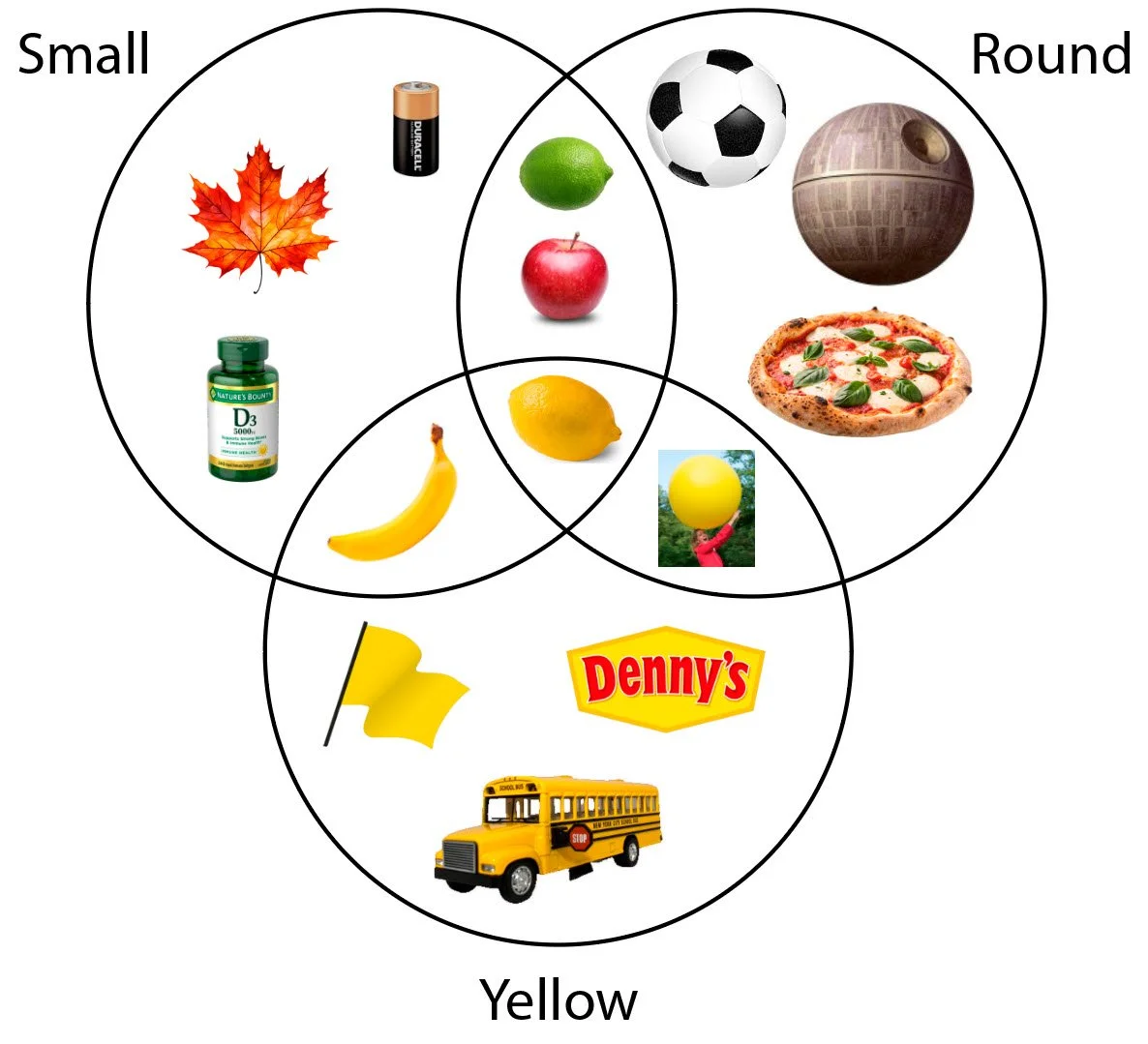
In this example, all 3 inputs come from the outside - sensors feed votes into the current search frame. But actually, information becomes available on a rolling basis. To handle this, additional information is fed to the current search from internal measurements: memories. These can be memories from a moment ago, or years ago.
Perception occurs on a Rolling Basis
Let’s examine some perceptions and misperceptions to see how information is processed on a rolling basis. Let’s consider this lyric:
There’s a Bad Moon on the Rise
Lyrics are often misheard because annunciation is altered from it’s normal speaking version in service of the song. Lyrics are not a 100% match for the spoken memory they hope to connect to. In the song, the word Rise is not clearly annunciated at all. It’s really just “Riiii…”. The vowel is extended and the consonant ‘s’ is gone. So really it could be the beginning of Rye, Ryes, Rice, Ride or Right.
To resolve this, the song MUST rely on votes outside of the current sensory input frame - the search is resolved from context. When the brain is processing the audio word “Riiii…”, it will remember the word Bad Moon which was identified in a previous time frame (a second ago). Audio for Bad Moon is gone - it’s not part of the current sensory input. However, the memory of it being processed a second ago can be cycled back to vote along with the current audio syllable for “Ri…”. All memories are in the same basic format - clusters of measurements. Thus the results from a moment ago (an internal memory) and the current measurements from external sensors, “Riiii…”, all can vote together.
In addition to the single perceived memory, Bad Moon, the brain can fan out to many related memories and use those also. Your brain is a connected network linking many memories. Bad Moon links to night, sky, halloween, witches on brooms, harvest, astronomy, sun, sundown, rise, stars, autumn and many many other independent but connected clusters. Those get to vote also. And it’s those Bad Moon-related memories that tip the scale and have the word “Riiii…” be perceived as Rise.
Perception is a search engine that combines votes from
Current Measurements (external sensors)
Recently perceived memories (clusters of Measurements)
Memories related to recently perceived memories.
It’s the related memory that tips the scale to Rise. If the song had mentioned Uncle Ben, the word might have been heard as Rice, etc. The McGurk Effect and the Brainstorm/Green Needle illusions demonstrate how this works.
Cascade Errors
Misperceptions often occur from a cascading error - one mistake inputs wrong answers to the next search. This lyric is a classic example:
There’s a Bad Moon on the Rise
There’s a Bathroom on the Right
If Bad Moon is misheard as Bathroom, then the related memories are different and no longer point to Rise. Bathrooms don’t Rise. Instead they are joined to phrases like “down the hall, on the Right”, and that tips the scale and has the word “Ri…” be perceived as Right.
ADHD
The entire system of building context heavily depends on balance. The first 2 categories above are pretty limited, but that third group is potentially huge: “Memories related to recently perceived memories.“
These are the basics of perception: The brain is continuously searching for memories which best match a combination of current external measurements and internal memories. This system requires a certain amount of balance. Without memories cycling back from the inside, there would be no context and perception would not be able to account for identifiers coming in gradually. But what happens if there’s too much information coming in from the inside? That third category - “memories related to recently perceived memories“ - how far can that go?
There really is no defined limit and ADHD occurs when it’s just too much. If you hear Bad Moon, that should put the related word Rise into the voting system and dozens of other things. But there has to be some cap also. What if it includes: Halloween, the street I trick or treated on when I was a kid, and the girl who lived down the block and how I fell for her 10 years later and we dated and she left me for that guy she met in Paris, where they have good croissants, gee that bagel this morning wasn’t very good. I should really take a baking class and do it myself. How much would that cost? How much did I spend on that concert shirt? When is Coachella?
And that’s ADHD. There’s no limit to the number of associations that COULD be found if associations are allowed to fan out. But there’s definitely a limit to what the search system can handle as input and still efficiently decode Bad Moon.
So what’s the balance? For the sake of explaining, let’s just say that to resolve the audio “Ri…”, we need a balance with 100 votes coming from current external audio and 100 cycled back from the inside.
ADHD is simply the idea that the internal votes will be way more. Instead of 100/100 let’s say it's 400/100 - the inside measurements flood the zone - you are “in your head” and not focused on the present. This makes identifications off balance and difficult. B&W text just compounds the problem: when reading, the 100 votes from the outside are split: 50 from shape and 50 from color. But color abstains because it’s all the same black. Therefore the voting is now really 400/50 with 50 abstaining. Then you glitch - and that’s dyslexia.
So the balance is thrown off in both directions:
ADHD triggers dyslexia by funnelling too much information from the inside.
B&W text (enforced color blindness) triggers dyslexia by limiting information from the outside.